

Hermès Kelly vs Birkin: the real differences, sizes, style and which one to choose
History and origin: from equestrian icon to cultural symbol
The shared ancestor: the Haut à Courroies (1892)
Long before the names that now define waiting lists, desire, and the collector’s market, Hermès had already set a tone. The Haut à Courroies (HAC) appeared in the late 19th century as a large bag originally designed for an equestrian lifestyle: practical, resilient, and built on a construction pattern that would later inspire the house’s most iconic silhouettes.
The Kelly: from the “Sac à dépêches” to a new media era
The Kelly was born in the 1930s as the Sac à dépêches and, over time, became forever linked to Grace Kelly. The well-known 1956 image of her using it to shield herself from flashbulbs accelerated the myth and cemented its public identity as one of the great style symbols of the 20th century.
The Birkin: the birth of a myth (1984) and why it changed the market
The Birkin has an almost cinematic origin: 1984, a Paris–London flight, a conversation about the need for a truly capable bag, and Hermès’ immediate response to that demand. It began as a design meant for real life and ultimately became a cultural object.
Quick recap: the difference in 60 seconds
The most obvious clue: one handle (Kelly) vs two handles (Birkin)
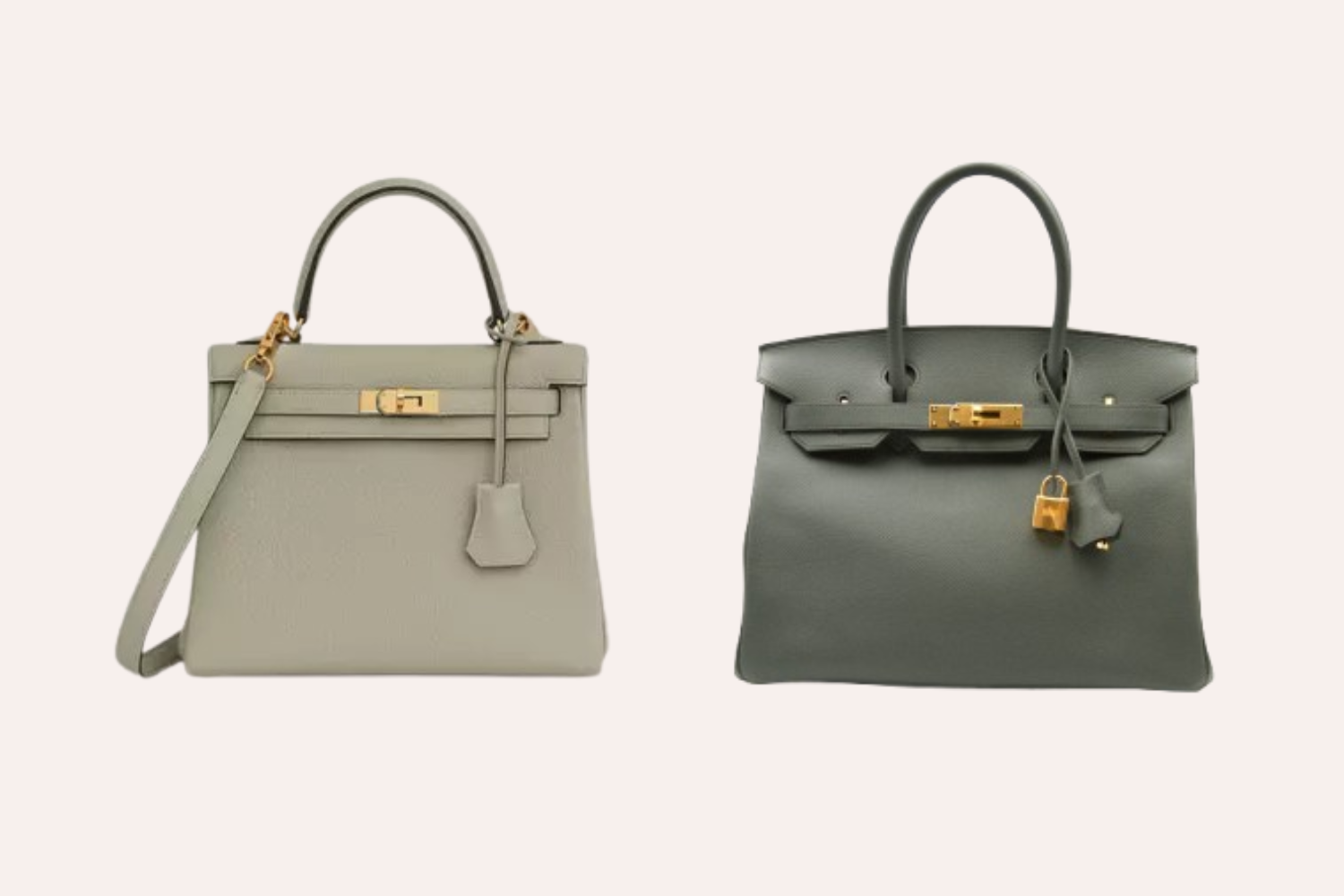
If you focus on just one detail: Kelly, one top handle; Birkin, two handles. That single design choice changes everything: how it’s carried, how it opens, and how it fits into your day.
Opening and access: more “open” and practical vs more structured and secure
The Birkin behaves like a luxury tote: it can be worn more “open,” with fast in-and-out access. The Kelly, with its flap and closure, feels more protected and ceremonial: the act of opening it is part of its charm.
Who each one is for (use, style, and lifestyle)
- Birkin: if you prioritize capacity, easy access, a daily rhythm, and a more relaxed kind of luxury.
- Kelly: if you’re drawn to structure, presence, and the versatility of wearing it with a strap (in many formats).
Design and silhouette: how to recognize them (and why they don’t feel the same)
Shape: trapezoid (Kelly) vs rectangular/tote (Birkin)
While both share Hermès DNA, the Kelly is often read as a cleaner, more architectural trapezoid, whereas the Birkin feels wider and more tote-like, especially in softer constructions.
Handles and carry: hand, arm, shoulder, crossbody (what each one allows)
The Birkin is designed primarily for hand/forearm carry. The Kelly, in addition to its top handle, features a removable strap in many models, opening up shoulder or crossbody wear depending on size and style.
Flap, sangles, and closure: how they shape daily use
Both play with a flap and front straps, but their “behavior” differs: the Birkin allows more spontaneity; the Kelly asks for more intention. And in day-to-day life, that difference is more noticeable than you’d expect.
Anatomy and details: a clear guide to the parts (with French names)
Birkin parts (what to look at and what each element does)
In the Birkin, functionality takes center stage: double handles, a flap with front straps, the hardware closure system, and the classic accessory set (padlock and keys) are all part of its identity.
Kelly parts (key differences versus the Birkin)
In the Kelly, the design feels more refined: a single top handle, cleaner lines, and a closure that often reads as more “jewel-like” as a whole. The removable strap (in many models) is also a structural difference compared to the Birkin.
Essential glossary: sangles, touret, plaque, clochette, tiret, clous…
- Sangles: the front straps.
- Touret / turn-lock: the central turn-lock closure.
- Clochette: the leather key cover.
- Clous: the metal “feet” on the base.
In an editorial piece like this, the goal isn’t to memorize French. It’s to understand which parts define the bag’s character and why some areas show wear first.
Sizes and proportions: which one is more practical for your daily life
Most common Birkin sizes and what each one suits
Standard Birkin sizes are measured by the length of the base and typically include 25, 30, 35, and 40 (with rarer exceptions and special editions).
- Birkin 25: compact, highly sought-after, ideal if you don’t want to carry too much.
- Birkin 30: the classic daily-life balance.
- Birkin 35/40: more capacity, more presence, more of a true “life bag.”
Most common Kelly sizes and how it “fits” compared to the Birkin
For the Kelly, common sizes include Mini (20), 25, 28, 32, 35, and 40. The nuance matters: a Kelly “fits” differently because of its structure, flap, and interior organization. Two bags with the same number won’t necessarily feel identical in real capacity.
Useful equivalences (if you like X in Birkin, consider Y in Kelly)
As a practical guideline (without claiming millimeter-perfect equivalences, because construction and leather matter):
- If you love the idea of a Birkin 30 for everyday use, it often makes sense to look at a Kelly 28/32 depending on how structured you want it and how you plan to carry it.
- If you want something compact and easy to wear, Birkin 25 often pairs well with Kelly 25, but the Kelly tends to feel more “closed” and formal.
Mini vs classic: what you gain (and what you give up)
The mini format is pure desire: proportions, gesture, jewelry-like charm. But the classic range (roughly 25–32) usually wins in real life: comfort, capacity, and harmony with an actual wardrobe.
Sellier vs Retourne and other constructions that completely change the bag
What Sellier is and what Retourne is (no jargon)
At its core, this is about how the bag is built and how its seams present:
- Sellier: sharper, more rigid, with a more “architectural” finish.
- Retourne: softer, with rounder edges and a more relaxed drape.
How they affect structure, feel, corners, and aging
Sellier tends to hold its shape with authority; Retourne often feels more “lived-in” over time, more organic. This affects how corners wear, how spacious the interior feels, and the overall character of the bag.
Which construction favors the Kelly, and which works best for the Birkin
The Kelly Sellier is iconic in its own right for its clean lines and presence. For the Birkin, Retourne has historically been the classic associated with the model’s practical spirit, though Sellier versions exist and can completely transform the aesthetic.
Leathers and finishes: what you should know before choosing
Structured leathers vs softer leathers (feel and drape)
Hermès works with a wide universe of leathers, but the idea is simple: more structured leathers reinforce a polished look (and often pair beautifully with Sellier), while softer leathers create a more relaxed feel.
How leather affects daily wear (marks, scratches, maintenance)
Generally speaking, grained leathers tend to disguise everyday wear better than smooth leathers, which can show fine scratches and signs of life sooner. Among the most popular choices, Togo, Epsom, and Clemence are often cited for their balance of aesthetics and resilience.
Hardware: impact on style, weight, and preservation
Hardware isn’t just a “color”: it’s light, contrast, and personality. On a Kelly it can feel especially jewel-like; on a Birkin it reinforces that utilitarian-luxury tension that makes it so desirable.
Capacity and comfort: the honest “what fits” reality
What fits in a Birkin in real life (no unrealistic promises)
The Birkin was designed around practical capacity: it’s a bag made to carry real life. Still, size rules: a 25 doesn’t play in the same league as a 35, and not everything “daily” fits into every format.
What fits in a Kelly, and how the strap changes everything
The Kelly organizes differently: flap, structure, and a more contained gesture. In return, the option to wear it with a strap (depending on the model) makes it especially comfortable if your day calls for hands-free ease.
Weight, access, and security: even the perfect bag has trade-offs
- Birkin: quick access, but if you wear it “open,” it requires more attention.
- Kelly: more protected, but less immediate.
Style: what each one communicates (and when it looks best)
Kelly: polished sophistication, more formal lines
The Kelly has something of a tailoring piece: structure, lines, and a refined kind of distance. That’s why it works so well with formal or minimalist looks. Even with jeans, it elevates effortlessly.
Birkin: relaxed luxury, effortless chic
The Birkin is the kind of luxury that doesn’t need explanation: capacity, an easy gesture, and that rare balance between exceptional object and truly functional bag. Its story began with the search for practicality without sacrificing design.
Looks and contexts: office, events, everyday, travel, city
- Office: Birkin 30/35 or Kelly 28/32 (depending on how formal your environment is).
- Events: Kelly for presence; Birkin if you want an “effortless” contrast.
- Travel/city: Birkin for capacity; Kelly if you value more security and a strap.
Market and resale: what tends to hold value best (and why)
What truly matters: size, leather, color, hardware, condition, full set
In the secondary market, value rarely depends on a single detail. It’s the combination that counts: in-demand sizes, leather, color, true condition, and completeness (accessories and presentation). What tends to be most solid is what’s truly wearable: balanced formats, a leather that matches real use, and an excellent overall condition.
Recent trends: the “Kelly moment” and what drives it
Some seasons see the Kelly rise in visibility: a more structured aesthetic, the return of “quiet luxury,” and the search for bags that work equally well day and night. Still, the smartest criterion is simple: choose the bag that genuinely fits your life and your wardrobe.
An iconic case that explains the Birkin phenomenon (cultural context)
The Birkin isn’t just a bag. It’s a story. And when that story becomes tangible through provenance, history, and collecting, it’s easy to understand why its place in luxury culture feels almost unmatched.
How to choose: a profile-based guide (no hype)
If you want a daily bag with easy access
Birkin, especially in balanced sizes, because it was designed around that idea: capacity and ease.
If you prioritize structured elegance and presence
Kelly, especially in Sellier if you love clean lines and a more formal aesthetic.
If you want versatility (hand + shoulder/crossbody)
Kelly: the removable strap (depending on the model) is a real advantage if you move around a lot and don’t want to sacrifice style.
If you’re buying with a long-term wardrobe vision (and future resale in mind)
Think wearability + lasting desire: truly usable sizes, colors that feel like you, and a leather that matches your rhythm. In resale, demand often concentrates on highly wearable formats and excellent condition.
Buying a Kelly or a Birkin second-hand: a smart checklist
What to check before paying: true condition, corners, handles, hardware, interior
With Hermès, condition isn’t guessed, it’s assessed. Pay close attention to corners, handles, hardware, and the interior, because these areas reveal real wear and the quality of care.
Documentation and “full set”: what often comes with the bag and why it matters
Without getting obsessive, the preloved market often values a bag that comes with its accompanying elements (for coherence, preservation, and traceability). Above all, transparency about what’s included and what isn’t matters.
Common red flags in the preloved market (without details that enable counterfeits)
- Vague descriptions or insufficient photos.
- “Too good to be true” deals that don’t align with the market.
- No clear return or verification policy.
When done properly, second-hand isn’t a shortcut. It’s a smart, sustainable way to access pieces that deserve a second life.
Get your Hermès Kelly or Birkin at Bags & Tea
At B&T, we select pieces with a curated, honest eye: bags that make sense for their condition, beauty, and coherence, and that match what you truly want (not what you “should” want). If you’re considering buying or selling a Kelly or a Birkin, we approach it the way luxury should be done: calmly, transparently, and with respect for the story behind each piece.